Dear Robin: Monsters in the Covenant
This is an archived post from Substack from August 1, 2025
Dear Robin is a three-part series of epistolary essays addressed to my incredible self-directed studies supervisor as a way of processing, decompressing, and reimagining the role of social work.

Dear Robin,
When I first took you on this journey with me, I wanted to take the community I’ve been so privileged to experience in the last few years and figure out how to extrapolate these systems of love and support into the larger realm of social work. In other words, I wondered if it would be possible to apply these small, localized systems of care into the seemingly insurmountable state-driven cycles of violence we mislabel as helping professions. I wanted to cast a wide net, as I’m sure you recall, and figure out whether small shifts can make big waves in the way our profession conceives of communities that it deems deserving or undeserving of care. I had a big picture in my brain, and people I wanted to talk to, but academia requires me to be specific and precise, and we simply didn’t have time. In many ways, I will be continuing this interrogation throughout my life, especially if I am able to stick around in this career, and I will be growing the way I dream the more I am able to connect with the dreams of others.
And so I return to the idea of community, and I find myself drawn to starting with the individual once more. Specifically, I find myself wondering what it takes for an individual to become (or view themselves as) a villain, and by extension, what does it take for our communities to become the things we despise and resist against? “Villain” is a dramatic word, but I feel captures in the simplest term the social outcast that not only refuses to (or is unable to) participate in community, but works to actively disrupts it. There is no shortage of discourse around Disney’s queer-coded villains attempting to disrupt the status quo, but it is the continual insistence that villainy is a binary that obscures the potential for wider applications of the word.
The idea that I am wrestling with is self-villainization and how conceptions of self act as barriers to community building. Jack Haberstam1 writes beautifully about the art of practicing failure—in particularly queer failure—and the community that can be built around falling short: “All losers are the heirs of those who lost before them”, they write. “Failure loves company.” Yet, even in a community of queerness and of failures, I wonder how fragile such a community can be. How long does it take for something wholesome and full of beautiful connections to fall into the trappings of capitalist thought like the tragedy of the commons? How long before we start deciding who is queer, who is allowed to be, and who is performing queer correctly? I recently came across a Substack article on “choice feminism”, as described by the author, Sunny Lu:
Never before in the history of the Anglophone world have women seemingly had such an array of choices for their lives in front of them as they do now–to be a girlboss or a tradwife, a “girl’s girl” or a “pick me,” a fake bisexual or proud heterosexual woman or … something else. I’m not sure. “Choice feminism,” as a lived, practiced, and debated online philosophy has become an embedded part of queer discourse when it comes to social media phenomena and criticism.
I appreciated seeing this list of labels entirely stripped of their moral connotations, despite the clear juxtaposing of each pair. In taking on a label, there is a certain amount of pressure one surely feels to “fit in” and to perform their label adequately. Even if there is no self-fulfilling prophecy in play, there is a certain degree of fear that might bind a group together. I think of schisms within anarchists and niche kink communities and fundamentalist religious groups alike.
There is a great essay about cringe culture becoming a method of self-policing and policing others. In it, Prince Shakur talks about the nostalgia younger generations have for the earnestness in which millennials were able to escape and be themselves online. Calling something cringe inherently assigns a negative valence to a behaviour, and he goes on to discuss Foucault and the panopticon and the state of constant perfectionism to avoid the shame of cringe. This perfectionism, in turn, polices membership status to individuals and further isolates individuals from participation in larger communities. The tension comes in Shakur’s example of the changing punk movement, where on the one hand there seems to be a collective desire to revitalize and move toward anti-establishment politics, but on the other, there appears to be a concern for whether folks are performing punk correctly, particularly as young people are attempting to join from a decontextualized and ahistorical place. (Side note: As someone who admires and may harbour some level of punk thought, but has never been involved in the subculture,here is a great essay on the context of the movement and the current state of how this term has been co-opted by fascists and liberals.)
Of course, communities contain multitudes of identities and multitudes of dynamics that cannot be so easily dismissed through abstraction. In thinking about the process of creating sustainable communities of care, however, I feel like it is important to simultaneously illustrate sustainable conceptions of the individual. When we turn against ourselves and our own values, it feels inevitable that our communities suffer as well.
There is an old James Clear quote I think a lot about, back when I was siloed enough to think that folks like Brene Brown were the only people who understood humans and systems differently (which is rather hilarious to think about now): “You do not rise to the level of your goals. You fall to the level of your systems.” There’s a lot to unpack in this quote, particularly pertaining the underlying privileges and assumptions, but I do think about falling to the level of our systems a lot. In particular, I think of us with the privilege to resist, yet find comfort in the systems that have given us these privileges in the first place. (Side note: I waffle all the time about the things I’ve gained as a model minority—the deeply programmed thought that perhaps the relatively mild yet persistent racist encounters that I’ve had in my life, for example, is a fair price to pay for occupying space. Must be nice to be included, as some may say.) Lucretia McEvil talks about doomerism as a response to excusing inaction—a way of performing care that actually defaults to the status quo. They talk also of revolutionary optimism as a way of pushing past the helplessness those in power want us to feel.
When our actions make us feel like villains in that broadly discomforting way, I want to imagine a world in which we do not default to the systems that drove us into that position in the first place. Instead, I want to hope that the strength of our internal selves can create a stronger network of our connected, relational selves.
Even when the circumstances feel like it will do anything to keep us from getting there.
Heroes, Monsters, and Ruthlessness

In my post about masculinity, I explored the idea of individual burden through the metaphor of Frodo. Another so-called hero that has been at the top of my mind recently is Odysseus, as rendered through Jorge Rivera-Herran’s musical project, EPIC. I’d read The Odyssey many years ago and most chapters of Odysseus’ journey home are familiar from my years studying literature. EPIC, however, manages to breathe new life into this journey and through its series of rock scores and theatrical ballads, paints Odysseus as a self-aware, romantic, and woefully tragic yet relatable figure.
At the start of EPIC, Odysseus has just finished fighting a war, and in one of his final tasks, he must kill the baby of the enemy prince. To set up the trajectory of his journey, he sings his recurring character track, “I’m Just a Man”, which asks:
But when does a comet become a meteor?
When does a candlе become a blaze?
Whеn does a man become a monster?
When does a ripple become a tidal wave?
When does the reason become the blame?
When does a man become a monster?
Over and over, Odysseus’ even-handed kindness and wisdom is tested. As the King of Ithaca, his one dream is to return to his country, his wife Penelope, and his son Telemachus. As the general to his 600-men army, he has a duty to the men who follow his command. Over trials and tribulations, his sense of justice ripples into devastating consequences, and he is faced with impossible choices, and over time, the Odysseus abandons his refrain of “When does a man become a monster?” In one saga, he angers Poseidon, who chases him across the ocean, framed by his song “Ruthlessness”, and his 600-men army soon dwindles down to one. By the end of his journey, he is alone as he echoes Poseidon’s relentless refrain of “Ruthlessness is mercy upon ourselves.”
The opposite of ruthlessness in this story was the character of Polities, who tells Odysseus to greet the world with open arms, and it was his death that first drove Odysseus into a rage, leading Athena to abandon him until his journey inevitably hardened him. He was supposed to be a “warrior of the mind”, and his softness falls short of her expectations. Over twenty years, Odysseus had been pushed to sacrifice six hundred men so he could see his wife again. In the finale song, he tells Penelope that he is no longer the man she once knew and loved—he is no longer gentle and kind, and he has too much blood on his hands. Yet, as the man who overcame in a world that revolves around a sole hero, he is rewarded by unconditional love.
At his core, Odysseus’ North Star was not rooted in values of love and community. He was a man battling with binaries he could not escape, driven by the need to see his wife above all else, and through that logic, monstrosity feels impossible to escape. It is the way despair encroaches on anger, and the shaping of anger as something counter to love. Being ruthless might feel protective, as Poseidon said, but what happens to us when we don’t feel like we can protect ourselves? What happens to us when the only way out is to harden the soft parts of ourselves? Soon, anything can feel like a zero-sum game, I imagine.
At the same time that I was listening to Epic, I was also consuming Love Island USA with a group of friends. It was my first foray into reality dating shows, and I was fascinated by the emotional stakes I observed among its participants and among other viewers of the show. Within the illustration of the panopticon, the islanders and viewers were much like prisoner and guard, and I felt—as someone less invested in the show but was invested in the phenomenon—like the abstract third party as discussed in my first letter to you. In pondering this, I wondered at which point even the most emotionally secure human would crumble under the intense surveillance, the agendas pushed by production, and the scrutiny of millions of people watching and discussing your every move. I can’t imagine surviving a day, personally speaking, before I feel pressured to embody someone I can’t recognize. I wondered, under those conditions, what it would mean to turn against myself and my values and how I treat others in those circumstances. Undoubtedly, each person has their own agenda that is worth the public scrutiny, but the morbid curiosity of Truman Show-esque makes monsters of the viewers too and how quickly we are to fall into moral judgements. How quickly we give up on values we hold tightly for what feels like inconsequential entertainment, thus peeling back layers of truth we may not have had the courage to say out loud. In some ways, perhaps, criticism of the contestants is inconsequential, but I do think there is something to be said about what constitutes the right behaviour within a heavily policed state that speaks volumes to our collective humanity—even when everyone seems awful.
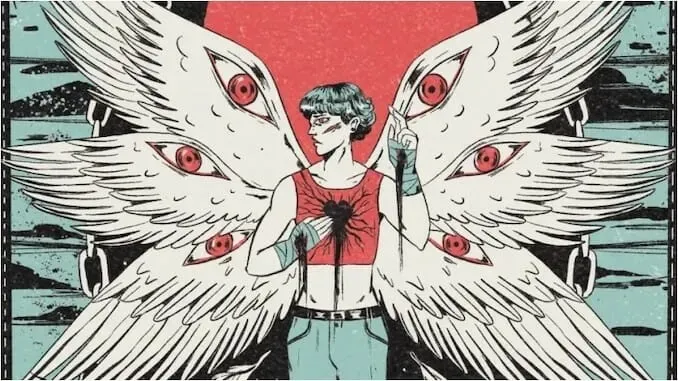
In discussion with a friend about monstrosity, I was recommended Hell Followed With Us by Andrew Joseph White. Set two years after Judgement Day, as the radical conservative Angel Movement calls it, nine billion people have been hit by the Flood virus. Many die in grotesque ways, but many bodies also turn into zombie-like monsters called Graces (or abominations). Graces are powerful, near indestructible weapons that Angels manipulate to kill nonbelievers, and the only one who can truly control a Grace is a six-winged monster called the Seraph. The protagonist, Benji, is a trans boy who’d run away from the Angels, and laying dormant within him is a Seraph. He tells himself to be “good” so that he does not have to awaken the monster inside, but there is also a sense of inevitability—particularly as his body begins to slowly change—of doing the least amount of harm as he braces for losing himself completely. Violence begets violence begets violence, Benji reminds himself over and over. And yet, the temptation for violence, especially in resistance against an even more violent, oppressive force is always present. This might feel even more salient to Benji, who was raised in an environment where the “other" (anyone not in community) is violent, unreasonable, and aiming to hurt you.
Where Odysseus paints a rather straightforward line from man to monster, he is also in a position of power few experience in their lifetimes. Few of us will (hopefully) be forced to make decisions with such exorbitantly high stakes. Rather, most of us likely feel our self-conception shift in far subtler ways, like Benji and the contestants of Love Island do. Constant scrutiny of ourselves and others, constant assessment of belonging and compromising with the needs of the self and the needs of the community—there is a delicate balance whether or not you are appealing to the masses for on reality TV or in a post-apocalyptic setting where communities are divided into neatly understood in and out groups. The role of self within community can be so easily lost in translation. Even among microcosms of friendship groups where membership is tied up in love for each other and can therefore encompass identities of all kinds, conflict can still put groups to the test.
I wondered, in discussing this with a friend as we were walking along downtown Vancouver, what the breaking point was—either within an individual or within the group—and we landed on apathy. More on this in a bit.
Collective Responsibility/Collective Monstrosity
In a recent Socialism 2025 panel, Andrea J. Ritchie describes an attempt by a group of abolitionists to create a legal framework for the fictional, Black utopian state of Wakanda. In her example, she illustrates how quick it can be to create the same monstrous systems that we are actively resisting against—how quickly citizenship, class, surveillance, and other modes of state oppression fall into place. In Marvel lore, Wakanda’s greatest resource is vibranium, a powerful fictional metal used to suit up villains and heroes alike. When such resources exist and we must negotiate membership, it seems inevitable that citizenship and surveillance should follow. Ritchie uses this example to beg the question of how much these systems are embedded into the inherent idea of the state, thereby positing the reality that no state can be anti-oppressive. Therefore, we must imagine beyond the state to reach our anti-oppressive dreams.
Much has been written about borders and states and the state of the state as a concept, and I want to resist the urge to doom spiral into all the ways our marriage to these inherently made-up concepts impede our own dreams of liberation. Instead, I pondered whether there was an exact moment in which an individual can turn against themselves in a way that turns against the community. There are physical manifestations of this—rising cycles of violence against and within communities, for example—but I wondered whether there are spiritual manifestations too.
In other words, apathy.
I’ve noticed recently the ways that I default to apathy whenever I am in a place where radical optimism feels too hard. To me, apathy isn’t even hopelessness—it is moreso a rejection of hope and care, something like acceptance and commitment to a reality you do not enjoy for the sake of overcoming it. There is perhaps a protective quality to apathy that speaks to the way we’ve learned to survive. Apathy feels easy—we see it around us all the time. And yet there is undoubtedly a feeling of distress too when I feel myself driven by it. I want to recognize too that apathy can be additionally protective in a world where everyone is expected to care about everything at all times—we are constantly inundated with distress and in the panopticon of today’s world, moral judgement is put on both action and inaction. At the same time, apathy can also shift the direction of our movements and impede our access to each other.
In Hell Followed With Us, Benji and his ragtag gang of queer teens protect the rest of their community through trade with the Vanguard, a community made up of white families who hoard key resources for themselves. In exchange for food and medicine, the teens must trade evidence that they were able to slay monsters and Angels and therefore protect the survivors. The Vanguard outsource their violence to children and display little care, withholding key supplies when the evidence of their slaughter are less than perfect despite the cost of lives to procure it. In survival, one would expect one’s best chance would be to work together against the common enemy, but in many pieces of media, survival is depicted as a tighter grip on one’s belief systems. In this world, likely extrapolated from our own, homophobia and transphobia breeds apathy even in a setting without a dominant majority, and apathy deems these children as disposable. Yet necessary.
Over the last two years, I’ve often felt immense pressure to resist apathy among my peers. It often felt like my friends and I were a broken record whenever we talk about justice, yet where we discuss things with hope, we’ve been told that we’re “depressing” even when we try our utmost to make things feel more palatable. It’s exhausting to feel like our humanity could be negotiable—more exhausting still to be the only one in the room who sees it that way. To be honest, Robin, I’m new at the community thing, and it’s easy to trust it when I feel connected and hopeful and raring to go. It’s less easy when I feel myself retreating and bracing for disappointment.
I think in this moment about Tick Tick…BOOM! and the finale song, “Louder than Words” and specifically these three verses:
Why should we blaze a trail
When the well-worn path seems safe and so inviting?
How as we travel, can we see the dismay
And keep from fighting?
What does it take
To wake up a generation?
How can you make someone take off and fly?
Robin, I’ve always admired the way you seem so rooted in justice. You’re such a trove of knowledge, and you’ve been so instrumental in helping so many of us make sense of this crazymaking time. Do you feel a responsibility, as I do sometimes, to “wake up a generation” as Jonathan Larsen says? I can hear you ask what that means, and my thought right now is to simply be less apathetic. What does it take for social workers to start investing in anti-establishment movements and not close up every time topics of justice bums them out? Perhaps that is too simplistic.
I’m told that it’s a better use of energy and resources to care for those already open to your community, rather than pulling reluctant people into aligning with your way of thinking. Connect with the many social workers doing amazing work, resist in whatever ways possible in the systems we work in, etc. But this line of thinking so quickly falls back into the idea of membership, of performing labels incorrectly, and creating binaries that enforce moral distinctions and villainization.
I know that it is possible to love those who cannot love us back the way we need. It’s possible to love others even when every other aspect of their beliefs do not align. It’s possible to dream alongside people you do not love and wish for a future where you could.
So, what is social work really for?
I heard it said recently that social work makes sense of the things that don’t seem to make sense on the surface: it makes the unseen seen. Whether it’s making sense of behaviours, relationships, or systems, we have so much potential as a conduit of meaning-making and meaning-connecting.
Community work is necessary to make sense of the monsters that haunt the individual, to hold them when self-villainization tells them they do not deserve to be held. The way writer Michael Rance describes his experience speaks volumes to the ways that we are expected to heal in a vacuum—the things we do to “fix” the parts of us that we’ve turned against ourselves”:
Sometimes I think that if I find the specific moment that I broke, I could trace the fracture and begin to seal the cracks. I recently re-read some of my journals for this purpose. It was an excruciating experience. Imagine reading a novel where a character keeps making insanely stupid decisions, and relentlessly self-sabotaging at every opportunity, only to realize that each disastrous decision was one you had made. The entries encompassed hundreds of pages of terribly human behavior. Too much drinking, too many internet dates, and far too much time staring at a phone and being sad. Hundreds of breadcrumb trails of destruction leading nowhere and everywhere.
This month, I thought a lot about breaking points, whether it is the individual or the community, or the relationship between the two. What is too much, and how do we know? When they say that’s the straw that broke the camel’s back, is it more about the straw itself or the mountain beneath it? In this metaphor, I think about the futile way we avoid the final straw, or somehow convince ourselves we have the means to make each straw as light as it can be…or we simply need stronger camels. I wonder if it is more helpful if we can instead reinvent the straw, or the role of the camel, or…figure out why we are piling straw on camel in the first place? In a way, perhaps villainy is the most revealing thing we can examine, and it’s the camels that refuse to carry the straw that can perhaps show us a different way of being, even if those camels disrupt what we know camels to be.
So much of human suffering is completely manufactured. Naomi Klein talks about disaster capitalism and shock therapy as an economic stimulant—violence and suffering that decimate the environment and our collective humanity. Even on a good day, it feels like there is more tearing us apart than holding us together.
Perhaps it is inevitable that communities fall apart, particularly as they are put through the gauntlet every day by so much suffering. It’s also possible that communities are fluid, ever-evolving things, and it’s as Black anarchist content creator, Prince Shakur, says, “communities may not last, but we can view that in different ways—it can stop us from engaging, or it can embolden us to be a part of larger movements.”
Ultimately, social work needs to be part of those larger movements, particularly those rooted in justice and joy. Simultaneously, there is a lot of power in the individual, and a lot of power that can be harnessed from the healing of individuals within our communities. At the Siyaten Festival I went to a few weeks ago, we watched Dallas Arcand dance with twenty hoops in a dazzling display of mathematically precise athleticism. On stage, he talked about overcoming adversity and passing on joyful things by first leaning into it yourself—you learn to be resourceful, I remember him saying, and you pass it onto the next generation. This principle feels important for all of our movements, and I am reminded over and over whenever I read amazing thinkers and writers of our time that we do not need to re-invent the wheel.
We need to lean in, pick up the torch, and make sure each iteration of our growth is rooted in our values and our faith in the beautiful futurity of our collective imaginations.
A Few Final Words
Robin, it’s been amazing sharing in my thinking with you. I don’t know yet that I have any or all answers to the tensions and resistances I have to this profession, but I also have hope that we can do better. I wonder sometimes if I am simply writing in circles, but I also can’t help but see everything in circles these days. I said to a friend the other day—and I think I truly believed it at a time; I might truly believe this sometimes—that humans are just patterns, and patterns are easy to understand. Patterns are also, to borrow the idea from K-Pop Demon Hunters, the things that can cause so much undue hardship. My friend gave me a look that pushed me to clarify: behaviours are patterns, and patterns tend to be cycles—cycles are easy to identify and hell to break. Humans as a whole are maybe more of a soupy seven-layer dip where those cycles hide.
Still, I think patterns on my strong suit, and it’s the recognition that it’s all patterns sometimes that gives me both extreme hope and extreme despair. Hope, when a way to that luxury gay space communist utopia we yearn for doesn’t feel so far away or unattainable. Despair, when confronted with how many disappointments will come our way until then.
As you know, I embarked on this journey because I feared that I would not last long down this path. But for all that I presume to know about patterns, it has taken me a long time—a lot of reading and learning and paying attention—to understand how truly not unique I am with all that I carry.
I wrote on the expansion of capacity for spiritual pain a while back in an article about Marvel witches, particularly as one who holds frequently tokenized identities. I was inspired by what I saw around me. I thought a lot about how expanding one’s pain tolerance never means less pain—only that we can take on more and more in newer and more insidious ways. Or old, familiar ways that feel comfortably nestled within our childhood wounds. I think about this in the context of work, and what it means to build resilience and distress tolerance in this line of work. At what point, I can’t help but wonder when I reflect back on my time in education, does resilience become apathy?
The one thing I’ve been able to count on through my journey has been the support of all the amazing people around me. When I zoom out of myself and sit in rooms full of incredible thinkers and doers, I am in awe of how small I am in the best way. As a single piece of a far larger puzzle, moving and meandering through the larger relational amoeba of being, I feel the uncertainty of the future as hopeful. That side of me is what derives wonder at the unknown, and she’s such a sacred part of me that I don’t always remember to nurture.
I fear, Robin, that through all this writing I simply have more questions than answers. Yet, I am grateful to be in community with you and others, because your responses have returned so much wonder to me. I still think about the orange glow through the leaves of the poplar tree. You asked me once whether I have been thinking about activities and interventions and other practical applications to all of this thinking, and my gut response was, “Holy shit, do I even know anything?” I am still, of course, thinking about queer utopia as intervention—that will never not be in my mind—but I have been thinking about the value of stillness too. (I’ve yet to do a deep dive on mycelial frameworks for future-building.) In honouring my communities and my dreams for the future, and in deference to moments like your orange glow, I have been thinking about how to reframe the inner monster I reflected on at the beginning. The more I sit with the feeling that maybe we are all Benji waiting to become something unrecognizably other, the harder it is to justify a world that seeks to make monsters of us all.
Just as the more I sit with this conclusion, the harder it is to find a neat way to wrap it all up. Maybe there is no neatness here—just stillness as I come to the end of this leg of the journey. These days, I often find myself opening up to possibilities of emptiness. In stillness and in emptiness, perhaps, we can make space for all the grief in our little hearts, and in encircling that grief, both individual and collective, is where we find each other.
Let’s find each other again along this road.
With all the gentleness we can gather from day to day,
Florence
Haberstam, J. (2011). The Queer Art of Failure. In The Queer Art of Failure (pp. 87–121). Duke University Press. https://doi.org/10.1215/9780822394358-004↩