2024 Recap
This is an archived post from Substack from Jan 31, 2025
Like everyone else who bore witness to the multiple genocides, rising fascist ideology, anti-everything hate, and the writhing worms all of that has uncovered, I’d say that 2024 was a pretty rough year. The last five years has been a series of rough years that has tested each of our ability to rip the wool from our eyes, but this newsletter isn’t about that. It’s about the Moo Deng in between all of this—momentary reprieve, but not looking away.
For my first post, I’m reflecting on the last year through the images that have captured my mind and soul, and remembering the complexity of surviving a time that can be simultaneously so difficult and so joyful.
The Color Purple (1985 + 2023). Toward the end of 2023, I saw The Color Purple’s musical remake in theatres. I’d seen the original 1985 movie as a teen, but aside from remembering the desperation for QTPOC content in the early 2000s, I’d gone in with very few expectations. I then proceeded to watch both movies several more times throughout January, because wow, it hurt so good.
I found this story to be incredibly grounding in a time of so much uncertainty. Coincidentally, I was taking a class on anti-oppressive practice at the time, and my fascination with this movie had inspired me to begin digging around for other QTPOC films. One specific rabbit hole led me to a fascinating paper on the emasculation of post-war Japan and the queer films that followed1. I, of course, then spent way too long trying to scrounge up evidence of Japan’s first gay kiss on film. Sadly, I did not succeed.
ニコニコ大会 追ひつ追はれつ (1946):
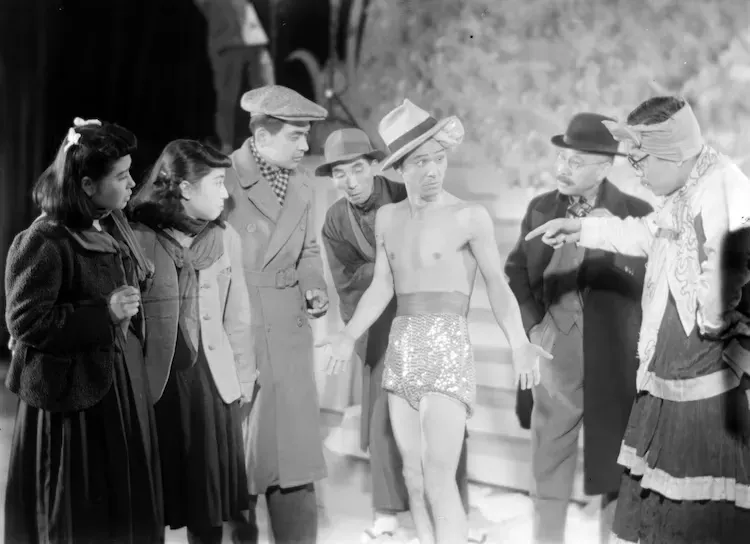
Of course, none of this has anything to do with The Color Purple, but it is a very good reminder that the world of queer media is vastly more interesting than we think, and much of it has been brushed aside for cultural slop like Bros (2022) to perform cis-white notions of “revolutionary” storytelling.
Triangle of Sadness (2022). If you enjoy Marxist principles of class consciousness and gasping a lot in movies, this is the one for you. Fair warning, this is not a movie you should look up beforehand, as the journey is really something to behold.
As it is difficult to comment on a movie without giving anything away, I will speak instead on Dune 2, which I had seen about a week before embarking on the epic that is Triangle of Sadness. Having never read the books, Dune 2 was extremely timely as a depiction of capitalist-imperialism that was difficult to look away from. To overlook such blatant depictions of oppression and leadership derived from personality and religion is truly to live in this world. My most vivid memory is exiting the theatre and hearing the crowd’s chatter and the deep despair of feeling so many of them miss the point.
Perhaps we all miss the point sometimes, maybe even willfully. I am reminded often that we truly live in a fishbowl of western imperialist culture, where we accept what is given and allow our imaginations to be stifled by the ignorance of others.
And so, we have to look to our poets and artists.
Sharknado 3: Oh Hell No! (2015) and Samurai Cop (1991). Speaking of poets and artists, I want to give a shout-out to the art of “bad art”. Before spending the latter half of my year consuming nothing but gay camp and Hallmark movies, there was a moment in time where my friends and I decided to pay The Room (2003) a quick visit. After the 20-minute compilation of the best scenes of the worst movie in the world, I was invited into the sanctum of Sharknado 3, which elicited an inexplicable kind of longing—we needed more of this goofy, weird time. This led us to Samurai Cop, a movie that was so odd and so racist, yet so painfully fun. It was the kind of movie, that made you question everything. Did I…enjoy that? You might wonder with a grimace. Then, as you tuck this movie in the back of your mind and hope it will never resurface, you might conclude that actually, maybe…that’s enough goofy for now.
For all that is so damn awful in the world, sometimes you just gotta have a laugh.
American Truck Simulator, Forza 4, and No Man’s Sky. During what would turn out to be one of the most chaotic summers of my life, I found a lot of stillness playing these games. ATS especially was a strange surprise, as I have never in my life held even the fraction of a desire to drive a truck. In my attempt to channel some of my thoughts into a place, I ended up filming a number of rambling vlogs as I drove across the American highways. Forza brought me a similar kind of joy, and it was here that I began to conceptualize a utopia in which all the cars in the world are replaced by the 1965 Peel Trident.
Forza 4 rendition of the Peel Trident:

Here me out: combining the micro-design of this two-seater and modern technology, we could easily fill our roads with these little guys to get us from neighbourhood to neighbourhood. Envision the shifts in the size of our roads, our highways, our parking spaces, and all of the extra room for designing green spaces. As the Trident caps at 70km/hr, any greater needs might be filled by train or rail. How the hell do you carry anything in this? You may ask. Well, as a proud owner of a sedan that fails to fit anything into my car anyway, I’m partial to the idea of a truck or attachment library (like a car Kitchen Aid). The truth is, not everybody needs a goddamn truck at all times.
The Wild Robot (2024). In a time of great uncertainty, where our whole world seems to be wired for failure, there was The Wild Robot. As I am writing these words now, democracy is falling around us at every level, and while democracy has not always served us—particularly as it was never intended to be put into practice—it provided us with a semblance of autonomy that no longer exist. We are pushing up against systems every day, despite knowing nothing ever gets done by playing their game. We fit ourselves into molds so we could be heard for a second, then brushed aside. We get back up, regroup, organize, and fight. Do it all again. I know this may not be the intention of The Wild Robot, but in this film, I saw what the emancipation from our programming could be. Even in the context of the film, it is temporary, but I hold hope that each time we dream a little bigger, our world grows in its capacity to get a little better.
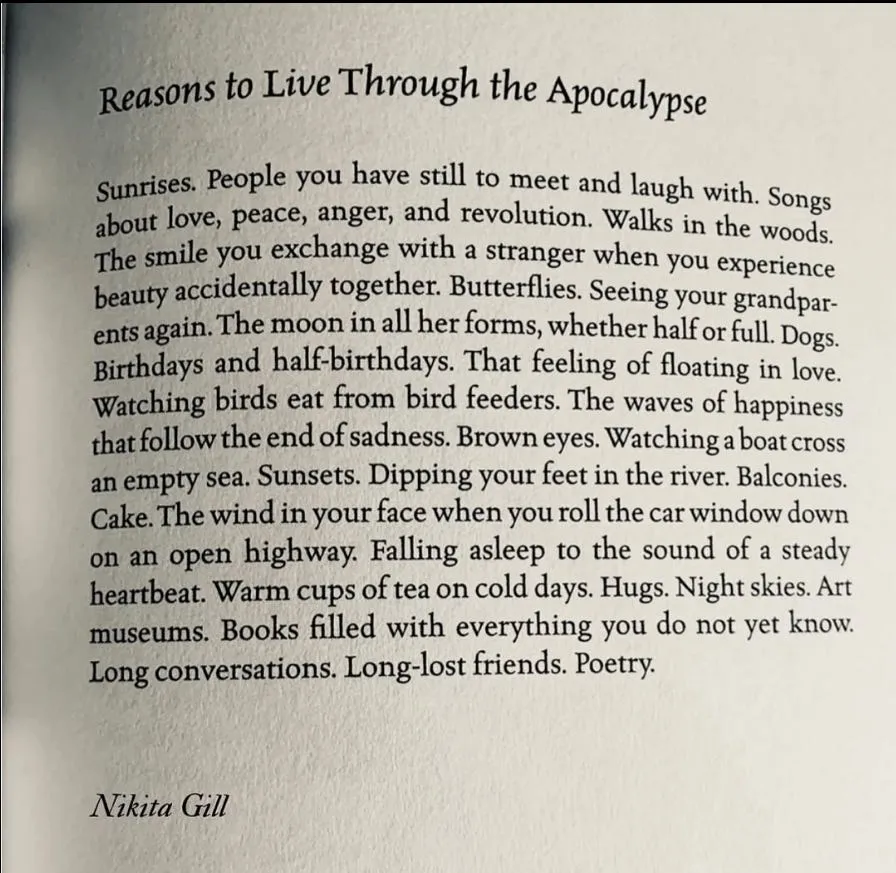
If you’re here at the end of this, thank you. My wish for this year is to consume the kind of content that gives me joy, and I hope I will be able to share that with anyone who wishes to listen. I’ll leave you all with a poem, and I hope I’ll see you all again soon:
@nikita_gill
Kenta Kato (2021) Kissing off the Defeat: Cross-Dressing as the Japanese Postwar Condition in Oitsu Owaretsu, Journal of Homosexuality, 68:11, 1860-1876, DOI: 10.1080/00918369.2020.1712141↩