K-Pop Demon Hunters: Of Simulacra and Omelas
This is an archived post from October 9, 2025
As always: spoiler alert for everything. Media discussed: K-Pop Demon Hunters, Steven Universe, Ursula K. Le Guin, Demon Slayer, and Taylor Swift
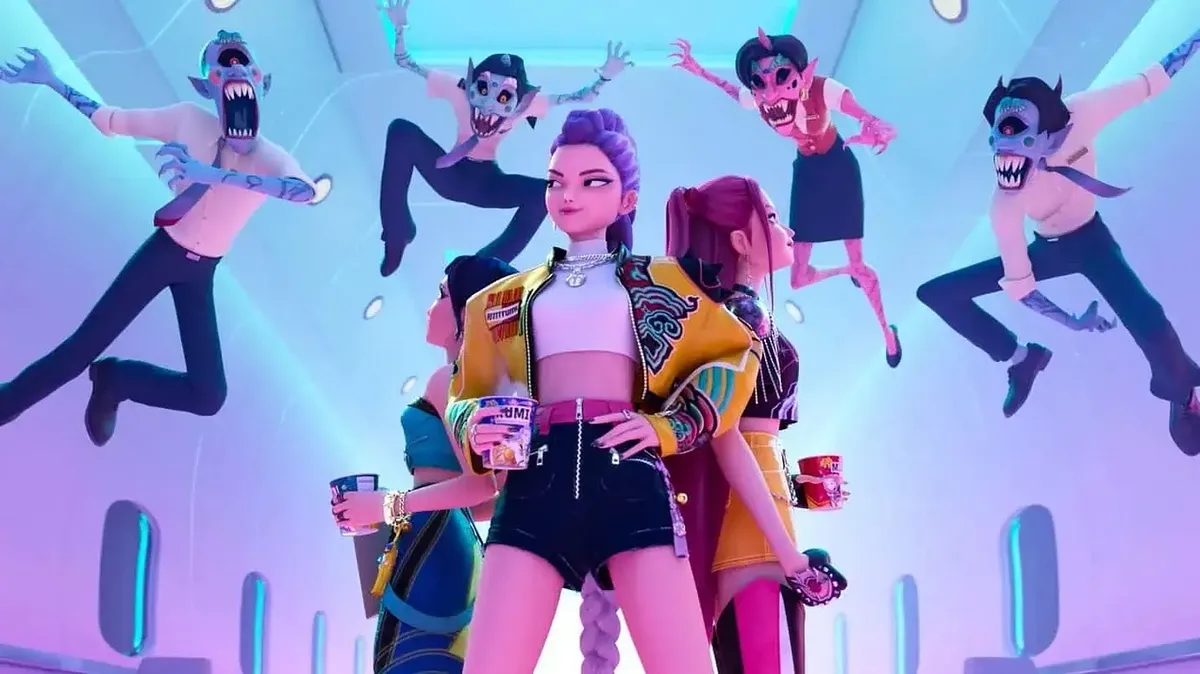
In the last two months, I’ve seen K-Pop Demon Hunters five times. What began as a lazy evening solo watch where I came away wowed by the visuals yet slightly unimpressed with the writing, I soon came to realize how much more there was to discover.
In my work, I’ve been thinking about and using the metaphor of the Honmoon a lot while it is burning up the zeitgeist. In a conversation about anxiety, it was hard not to think about Rumi’s journey—the harder she worked to fix something, the worse the thing got. It’s a relatable feeling and a familiar story of lies unravelling to the point of everything else simply breaking apart.
I think about this journey in terms of what we internalized within the empire too: the mythology of what it means to keep your demons at bay—the cost for productivity, perhaps—the rugged individualism of it all. Conceal, don’t feel, etc., etc. The obfuscation of daily horrors enacted by those in power—don’t worry about it, the Honmoon keeps demons at bay. Look away from those strange, unnerving feelings—someone, somewhere is taking care of it. Everything is under control. We’ve raised the best cops for the job. The sacrifice of a few will be the ultimate happiness of the many—if not happiness, then blissful ignorance that can at least construct some semblance of a life well-lived.
The Seoul of Omelas
Though stylized with bright colours, K-Pop Demon Hunters proposes a reality that is not unlike “Those Who Walk Away From Omelas” by Ursula K. Le Guin, except of course, nobody walks away. In this beautifully concise five-page short story, there is a fictional place called Omelas that is paradise on earth. Le Guin describes an idyllic kind of flourishing—harmonious and productive, tender and happy—but it comes with a cost. For the happiness of many, one child must suffer torturous hardship, locked up and cut off from society in every way. The child’s pain is public knowledge, and people of all ages visit the child. The highlight of the story is not the child, however, but those who have seen the child and choose to forsake paradise in order to rescind their participation in this system. It is those who subscribe to the revolutionary spirit of “no one is free until we are all free.”
Stories such as this, especially when skimmed across the surface, tend to be paternalistic: there are only the people and those who sacrifice for the people. Omelas is a utopian painting trapped in a state of imagination sold to the masses like a carrot on a stick, passed from generations to generations. In K-pop Demon Hunters, Demon hunters are treated much like the tortured child: three girls must sacrifice their lives to protect the peace—further the peace even—toward the building of Omelas. After all, once the demon world is sealed for good, evil will be gone and Seoul will be saved. What happens after that? Who will be left to blame, and what will happen to the girls?
I’ve always advocated the idea that Eastern collectivism is an orientalist myth, at least in the way it is often sold to us. Collectivism implies care for a group and all members within a group. While there are aspects of our culture—in speaking as an immigrant in the diaspora—that attempt to instil in us a higher level of vigilance toward care and compassion for others, that is not what KDH highlights. Rather, its treatment of the Other within its own ranks is evidence of collective intolerance to discomfort, rather than care for the collective itself. The level of shame Celine inspires in Rumi is not collectivism—it is rugged individualism pushed onto a child for the sake of protecting that collective intolerance to discomfort. Rumi, as a child, is tasked with the responsibility of diminishing her existence in order to create a more comfortable environment for the adults in her life. Huntrix is built around her, not to support her, but to cure her. It’s a story that many of us know well—one clearly intended to expose the struggle of upholding the model minority myth in the way so, so many East Asian stories do in popular media.
Celine, however, is one of the most interesting figures in the last half-decade of Asian mommy-issues media. I love her because she also feels the most realistic among the many parent-apologist films (and as much as she triggers something uncomfy in me, the fantasy of the parent apology often feels even more painful). She is astoundingly unhelpful, stubbornly consistent, and so deeply in the dark about her entire business that I would love a spin-off because what on earth does she do with her day? Going to the market, tending to her garden, and camping by the Han River, I hope. Fascinatingly, she is simultaneously feared for holding up oppressive standards even while she isn’t present and scapegoated toward the end as a key problem when things go wrong. She is, however, not the villain.
(And it’s oh so tempting to pick a villain, isn’t it?)
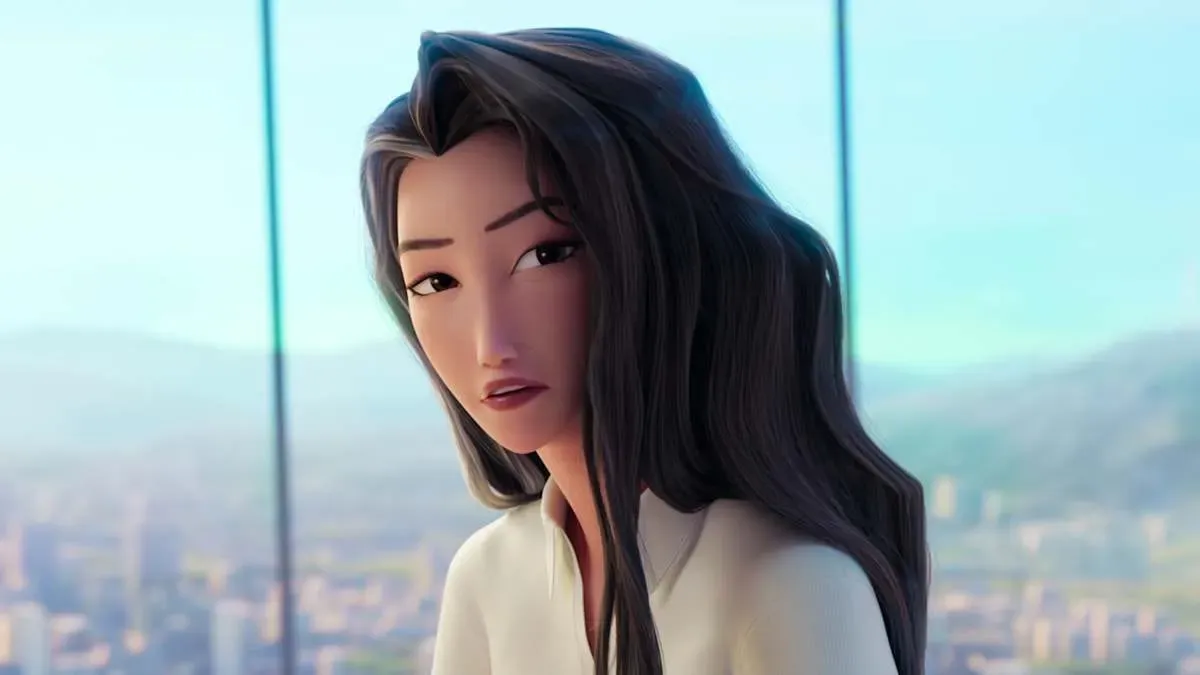
The hero narrative posits that there is no escape from the pursuit of Omelas. Defined by how far one must go to serve the people, heroes who walk away or stray from the path are anti-heroes at best—terrorists at worst. When I think about the years Celine dedicated herself to a singular cause, I find myself sympathetic—years of stardom, constant vigilance, and no real rest and retirement if her duty extends to mothering the next generation of Hunters. Celine can’t change her mind because changing her mind would mean that everything she has done in her life, built on binary of good and evil, is a lie. By the end of the movie, do we see a different reality for Rumi? What about Zoey and Mira? Though the ending is ambiguous, I’m not certain it would be. Celine isn’t a villain: she is the past, present, and the future if we can’t meaningfully break the cycles that imprisoned them into eternal servitude in the first place.
For meaningful change to happen, after all, one would first have to walk away from Omelas.
Demons in the Machine
We as a society are obsessed with demons, villains, monsters, etc.. Social outcasts who aren’t afraid to break moral codes, resist the oppression of what is good, and draw out the darkness trapped inside each of us. Obviously, it doesn’t hurt when our demons are also hot.
Heroes are boring. Villains are sexy.
The thing that fascinates me most about KDH’s demon’s however, isn’t the chokehold the Saja Boys have on their fandom—obsession with “bad” men warrants a much wider discussion and has no doubt been discussed to death by people who yearn for men more than I do (Shanspeare’s video on the intoxication of dark romance comes to mind once again). It isn’t the whole fighting your demons narrative, as if quelling your inner demons could be the solution to world-ending events (I love the idea of self-compassion; I loathe it as a distraction from the way systems blame individuals for systematic issues).
For me, I am interested in the optics of the normalization of violence against demons, particularly those on the lower rungs of the narrative hierarchy (aka anyone who is not Jinu).
While the movie does not depict evolution among demons and their status, I want to examine the hierarchy embedded in the different states of demonhood. In my opinion, this is perhaps best examined through the lens of normalized ableism.
I think of this quote from Sins Invalid, a disability justice primer. As first written in Kindling, Aurora Levins Morales says:
There is no neutral body from which our bodies deviate. Society has written deep into each strand of tissue of every living person on earth. What it writes into the heart muscles of five star generals is distinct from what it writes in the pancreatic tissue and intestinal trace’s of Black single mothers in Detroit, of Mexicans migrants in Fresno, but no body stands outside the consequences of injustice and inequality.
Bodies are inherently political—queer, Black, Brown, Disabled bodies even more so. It is easy, from what I’ve observed, to hold nuance for singular stories of extraordinary individuals (you’re not like others, they might tell you in a backhanded compliment). It’s hard to hold nuance when those stories are silenced, flattened into the side of a monolith, and in their absence, justify the extinction of communities. How the audience is made to feel about a body and the audience’s subsequent reaction or lack of reaction speaks volumes to the normalization of violence against Othered bodies.
The depiction of bodies among demons is interesting, ranging from the most human in Jinu to the fiery entity of Gwi-Ma, representative of the concept of shame-making and anxiety more than anything else (thus more of a conduit to Jinu’s villain to hero journey than a fully-fleshed villain). Outside of the spectrum of sympathy, I find myself thinking a lot about the demons destroyed by Huntrix in the background: eyeless, crawling demons and snarling non-speaking demons with only hungry, reptilian instincts. The further they are from the lived experiences of the status quo, the more monstrous.
In humans, different states of a body require different needs, but there is no doubt that certain needs are framed as evil when we look at our healthcare system. Non-speaking children, for example, are often treated as if they are non-feeling too, especially by adults trained to see “expression” in a very specific way. By extension, with Jinu given voice, language, emotions, and jokes, he is implied to be superior (read: more human) in some way to many others, hence more deserving of our sympathy. We can’t help but root for him, to the point where we, like Rumi, want to see him on the other side of the Golden Honmoon. He’s not like other demons, after all. Over and over, I find myself going back to the question: of what makes Jinu special?
And really, what does it mean to see our lack of compassion for Othered bodies even in this fictional world.
Through Jinu’s story, it is implied that all demons are created through selling their souls in a classically Faustian exchange. The demons who feel “incomplete” and further from human, in comparison, don’t have stories worthy of remembering, and serve only to pose a threat with their monstrosity.
These incomplete demons remind me of the shards in Steven Universe. (This will be one of two short but relevant asides, meant to illustrate alternative yet similar ways of handling Othered bodies.)
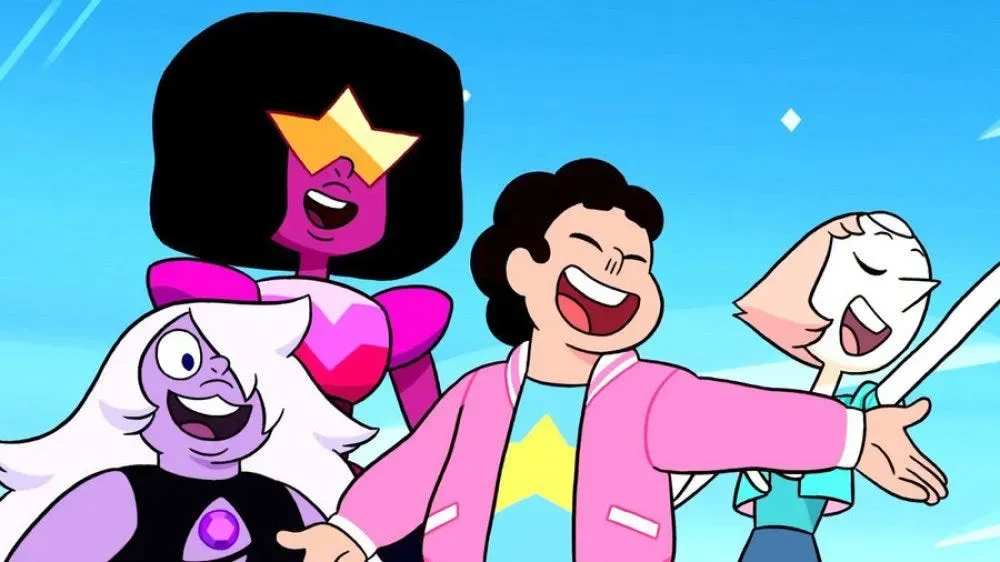
Steven Universe follows a boy named Steven and his ragtag group of alien earth-protectors made of gems, sole survivors of a great alien civil war that tried to destroy Earth. When gems are “killed”, their humanoid bodies return to gem form, where they regenerate over time. They only truly die when the gem itself is shattered. However, it is later discovered that the shards of shattered gems were used in the war, even fused to make monsters akin to Frankenstein’s. In fact, the earlier monster of the week format of the show is explained by this phenomenon. Gay aunt, Pearl, explains:
[The] shards have a powerful partial consciousness that has been harnessed by Gems throughout history to create semi-sentient drone soldiers with the capacity to follow basic orders. Gems once created an army of these drones but found their obedience waned as the shards overdeveloped inside their uniforms and turned on their commanders. You see, any shard inside any sort of container could become a monster!
To translate the context of this quote into our discussion, one who cannot be obedient, one who cannot be “reasoned with” because they do not look, feel, and express in the same way as those who can behave under a homogenous (read: hegemonic) set of expectations…will always have the potential become monstrous. And we have seen in the last few years what happens when we take that fear of monstrosity and conflate danger with feelings of danger.
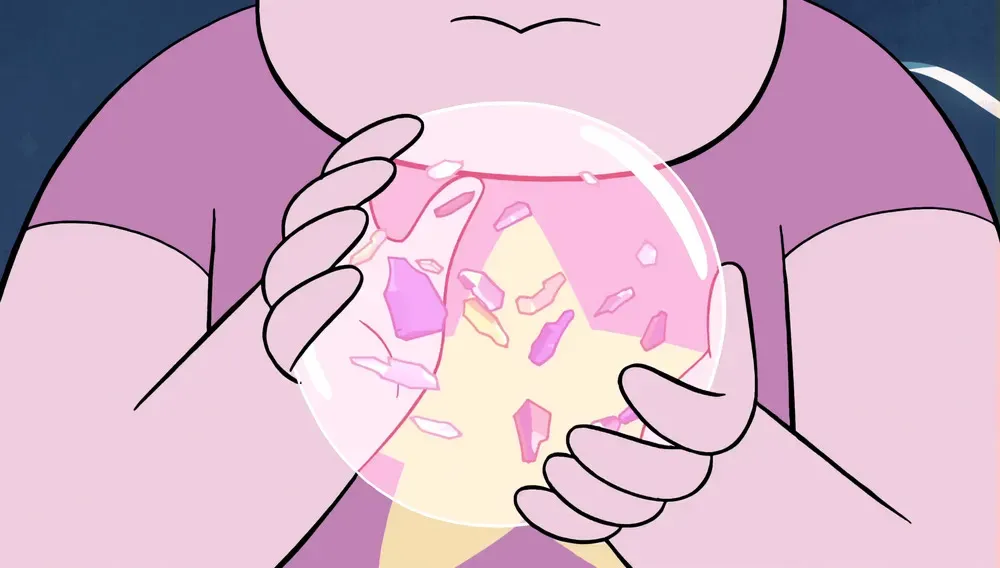
The Crystal Gems’ solution to this monster crisis is to “bubble” the shards in their inactive state, keeping them safe inside a dark chamber for eons. This is not the only time the show explores imprisonment—another character, human-presenting and tragically relatable, receives multiple arcs exploring the impact of PTSD and the trauma of false imprisonment. The show is absolutely brilliant in all that it tackles, but despite immense sympathy for the shards, the act of locking them away is not questioned—often only proved time again and time again why it is necessary...until much later in the series, when Rebecca Sugar makes the call to break the cycle again (as she has done so often in this masterpiece of a show).
K-pop Demon Hunters also contains these demon shards in a sense: incomplete monsters with singular directives. Sometimes hordes of them. The idea of a “horde” feel all the more sinister as a word that evokes a sense of orientalist scare in its usage. Demon Hunters, much like the Crystal Gems, patrol and protect humans from these violent creatures, removing them from sight using whatever means possible. Unlike Gem shards, however, we don’t know how demons are made, only that we are not meant to blink when they’re shattered. We can perhaps infer Gwi-Ma has a role—creating empty vessels that crave souls because they do not possess one (or because they live to serve their master and do not seemingly possess the capacity to do otherwise). Jinu, on the other hand, is a demon that had a soul, but gave it up to Gwi-Ma. He made a human mistake and is not inherently evil (unlike every other demon, the movie implies).
Plus, he can’t be evil because he’s hot.
What about the rest of the Saja Boys? They seem to exhibit charisma and personality only when it matters, appearing void and blank every other time. Strangely, they express themselves less than their water demon stans and the awkward flight attendant killed by Gwi-Ma, yet there is a fascination over them in the real world that seems to match and/or surpass (if my algorithms can be believed) the more dynamic members of Huntrix. Where are they on the hierarchy of sympathy for the storytellers, I wonder, and what do their inevitable deaths say about their place in this world?
Sidebar: Demon Hunters vs Demon Slayers
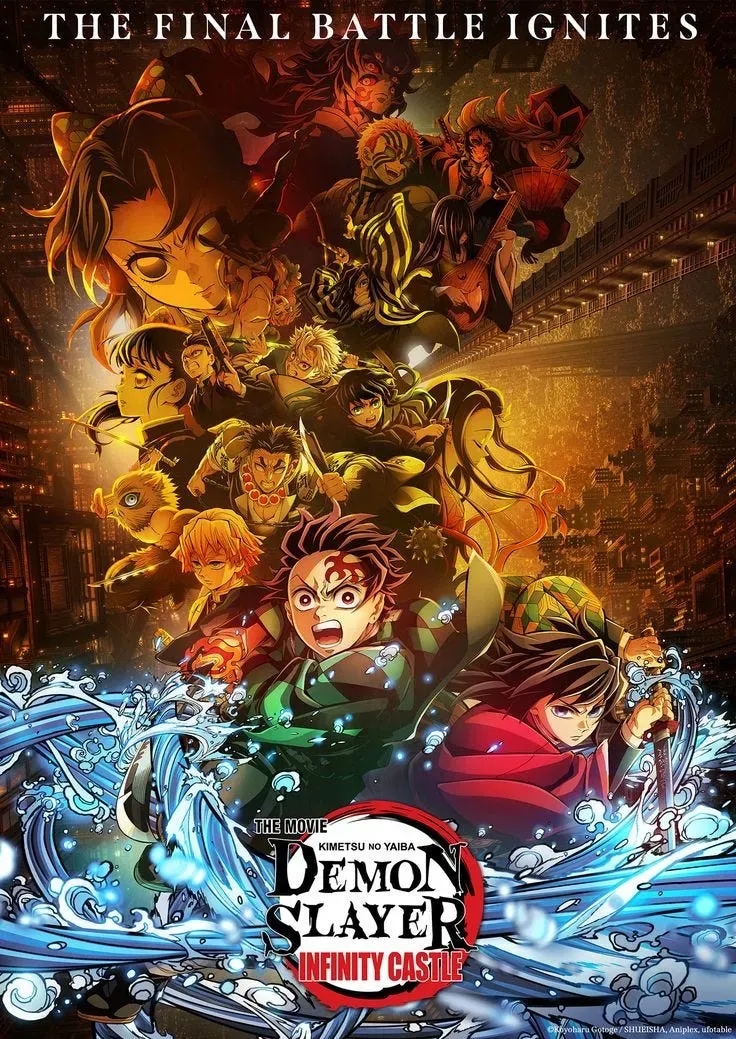
With the release of Demon Slayer: Infinity Castle at the time of writing, I’ve been mixing up KDH and Demon Slayer all week. I have a lot of issues with the anime, but it is fascinating to witness some of the parallels. I’m sure that it’s not a coincidence either, as Demon Slayer is nearly a decade older than Demon Hunters, younger if we are only looking at the popularity of the anime.
Demon Slayer feels distinctly Japanese to me, following old shounen genre tropes of screaming about strength and treating women terribly, narratively speaking. It is perhaps further removed from the sensibilities of North American media that makes K-pop Demon Hunters explicitly Asian-American, hence is able to maintain a narrative aesthetic that serves the Japanese audience first and foremost.
Demon Slayer contains a similar conundrum of demon hierarchy, and this is explained a bit more clearly than Demon Hunter. Demons have a clear source of creation in the Big Bad, Muzen, and status is granted to those that have taken the most lives/souls. The more you claim, the higher you rank, thus the stronger and more powerful you become. Sometimes, humans are scouted out to become demons, the most powerful among them becoming only somewhat grotesque to form a council of the twelve strongest demons in the world. There are monstrous, lower level demons removed from the human form too—hordes of them even—it is implied they were all humans once, but unclear why they are so disposable.
Many demons featured in the series have tragic back stories, much like Jinu (though arguably with a few more layers) and consent to demonhood is ambiguous in many cases. Stories of hope crushed and prevailing evils in the world doom these demons into sentient but eternally bloodthirsty beings—again, systematic woes that create individual responsibility (read: eternal vengeance) for tragedies outside their control, often due to poverty and trauma. Like in KDH and in Steven Universe, important pieces of their memories are taken so they could be effective soldiers for their master, only to be regained over time with some level of empathy as a form of liberation from their insatiable bloodlust.
Specifically, the main character, Tanjiro, and his capacity for empathy is a big part of the series, yet it is never in question that violence is the only way toward the end of violence. And there are plenty of storyless grunts dying by the sword of Tanjiro and his friends without a second thought. The Slayers, much like the Hunters, work tirelessly on their craft and even as humans with extraordinary abilities, are prone to human things like getting hurt and needing to push through world-ending disaster without rest or respite. Because we are conditioned by stories like this to pay attention to individuals overcoming hardship and coming out on top against all odds, we never have to look too closely on the circumstances that created demons in the first place. After all, no matter what happens, the extraordinary few will always prevail, and that’s all that matters.
The rest are simply casualties of a necessary war, most not even worth mourning.
Who lives, who dies? (Who tells your story?)
The interrogation of what demons are and who deserves sympathy is important because the way Rumi sees herself is important. The way Rumi sees herself is important because her narrative arc mirrors how we see ourselves and others simultaneously—“If you can’t love yourself,” as Rupaul often says, “how in the hell are you going to love anyone else?” Her self-loathing and later depiction of suicidal ideation is reflective of how little Hunters understand (or even attempt to understand) demons—it is easier to believe, after all, that there is inherent evil in Rumi’s existence (read: difference) rather than a bug in the entire system. The tenuous sympathy we have for demons may not extend past Jinu, insofar as the story is concerned, and it is difficult not to parallel this phenomenon against real-life othering and policing, both internal and external.
Here, I find “Free” to be revealing. The repetition of “you can’t fix it unless you face it” harkens back to the individualism within collective intolerance for discomfort. This duet highlights the pressure of attempting to “fix” yourself in order to function better within a system built to make you ill. Escapism isn’t enough to heal the perpetual state of unhealedness within two characters that are consistently asked to move mountains alone. Ultimately, “Free” is not a romantic song. Neither Jinu nor Rumi have the ability to set each other free without the immense upheaval of what’s keeping them trapped in the first place. It is a song of imagining, an anthem dreaming of Omelas without consideration for what it would cost, instead distilling complex dynamics at play into the simple act of taking one’s hand and repackaging it as a solution while maintaining one’s silos. It is a song that asks what it would be like to simply be free of the anger, the shame, and the pain, rather than what we can do to harness our anger, transform our shame, and distribute the burden of pain. Being free and floating into the ether holding hands is ultimately an unimaginative vision of utopia—though such imaginings often reflects a version of what people assume utopia to be. Queer utopias understand that it would be absurd to seek such a world—rather, we seek to create world where everyone is free to be angry, free to be hurt, free to be happy, and free to be still. Freedom is not a solo endeavour. It is a wholeness that requires a level of commitment to love that can disrupt the paternalistic silos of hero narratives.
Of course, in the context of this constructed world, it would be ridiculous to suggest that the Hunters should’ve done things differently. There was at no point, after all, where Rumi would’ve felt safe enough to dream out loud. In the context of the real world, however, we have to consider the implications of this film’s construction: in a perfectly paced 90-minute animated film designed to appease the widest range of audiences while staying true to Korean-American aesthetics, what do these instances of flattening—literary shorthands, so to speak—reveal in both the audience and the storyteller?
First, as previously alluded, there is liberalism’s favourite game of highlighting one bad actor, the source of all evil that makes criticism of systems and structures moot by the end of the movie: Gwi-Ma (and/or Celeste depending on how much parental trauma is in your pocket today). Like many hero vs. villain stories, the existence of the Big Bad theoretically absolves systems of creating Big Bads—even if it does not, a hero punching out a villain in a display of good’s triumph over evil assigns a sanitized image of morality that vaporizes meaningful engagement with its philosophical possibilities. In other words, it leaves no space for nuance, no alternative imaginings beyond the binary. While there have been many attempts over the years to subvert the hero narrative, it is still a convenient shorthand for individual triumph. It’s a simple goal we can all wait for a selective few to solve for us. Don’t worry, audience, the Big Bad will get their just desserts by the end, and all will be well. However “well” should be defined.
As such, this first trope lends itself to the second, the trope of the exception to the rule. In this case, amidst the unquestionable lack of humanity among other demons, Jinu manages to turn around and assimilate into the status quo of goodness just in time for salvation. He’s not like the other girls—by sheer force of will he’s able to reclaim his autonomy and find his soul to be martyred for the hero’s noble cause. His exceptionalism exposes the absurdity and unfairness of the rules in the first place—the fascism of the demon overlord and/or their imprisonment beneath the Honmoon. Ergo, if the rules are absurd, we can disregard anyone who follows them (aka every other demon). He is far from the only demon to die in this film, but he is the only one who is truly sacrificed by the narrative. It’s almost biblical: I died, so you can live. Never forget.
So again, what makes Jinu special? I feel that I must keep asking this because we live in a world where any and all of us have the potential to be demonized in a moment. We are living in a time where the most televised genocide in the world can garner no sympathy from those struggling under the propaganda machine.
Beyond his importance to the plot and to Rumi (even beyond the allegory of the self-acceptance arc he represents for her), challenging our limited sympathies for the demons is a way of understanding the parallel ways in which we challenge or don’t challenge the demonized Others in our world.
I think Mohammed Khalil’s opening pages of Perfect Victims draw the clearest parallel of the conclusions I am attempting to draw:
We die a lot. We die in fleeting headlines, in between breaths. Our death is so quotidian that journalists report it as though they’re reporting the weather: Cloudy skies, light showers, and 3,000 Palestinians dead in the past ten days…We pay no heed to corpses in our fields. Their existence is monotonous, predictable. The slaughter is so relentless, it is almost expected—anticipated—by the soon-to-be-slain.” He goes on: “For our martyrs to matter, they need to have lived as spectacular people or endured a spectacularly violent death…otherwise, in most cases, the slain are condemned to become another forgotten statistic, or even deserving of death. \
Israeli death, on the other hand, is another story, the main story. The love their dead receive is fiery, ardent, incandescent—it lights up the White House and Eiffel Tower. The globe grieves Israeli loss without qualifiers and morphs that grief into fuel for genocide. Here, grief becomes currency.
In another example, consider those we label monstrous in our so-called democracy: the oppression of our penal system and the statistics comprising the bodies we reject. In Rehearsals for the Living, Robyn Maynard talks about our willingness to turn a blind eye to criminals, proven or otherwise, to the poor, and to the wayward. Especially under the guise of safety.
In writing of the state of prisons during the beginnings of the COVID-19 pandemic, Maynard describes the way Black youth, barely 18, are often made to be kept in solitary confinement for 23 hours a day under the guise of safety. The alternative of letting them go home and shelter in place is unthinkable to the carceral state. She elaborates:
But instead, COVID-19 has made it all the more clear that, to paraphrase Angela Y. Davis, prisons exist to disappear from social and political life the people whose very presence otherwise asks us to account for the social, racial, and economic inequities of our societies.
The treatment, under the pandemic, of Black people, Indigenous people, homeless and trans and drug-using and sex-working and poor and migrant people, shows what it means to be rendered expendable. And it exposes quite clearly that we live in a society that is structured around mass expendability.
We live in a time where these simple, beautifully tied up 90-minute stories can be intoxicating, and in order to streamline such stories, it is inevitable that some bodies are simply more consequential than others. The death of hundreds upon thousands of demons is shorthand for the perseverance of “good”, and there must not be stories that contradict that. If there were, we—like Celine—would be forced to confront the ugly side of all that we are taught to work toward. Rumi’s existence is a very small seed of doubt in comparison to all that this movie upholds of the status quo (of ideas of good and evil, of duty and sacrifice). She is ashamed of who she is—appropriately in her context though undeservedly so—and has spent her life atoning, having done nothing inherently wrong that could sway the audience’s sympathy otherwise. Her arc is one of self-compassion, and does not actually challenge her worldview on demons to a meaningful extent, not even with the limited discussion of her father and Jinu. Presumably, the everyday slaughter of soulless demons is still on the table. Her life is one that has been spent in the noble pursuit of protection (read: enforcement) and overcoming the self-loathing in the process is only radical to a point that doesn’t rattle the whole system. That, in a nutshell, is the reality of orientalist notions of Eastern collectivism: East Asian trauma vying to be seen while pandering to the West, sold to us with equal parts loathing and admiration while the rest of the world stands invisible to us (no matter how many of our stories parallel and intersect in our suffering). It is as if there is only two ways to be: two sides of the Honmoon to be on, and as if that has always been throughout the rich and tattered tapestries of our history.
So, here is one answer to why Jinu is special: he was not only spectacular as a demon, extraordinary in how few others garner the same level of sympathy, his narrative sacrifice is also fuel for the decimation of all other demons. By the end of the movie, the demons are now assumed to be confined out of sight to the other side in a new world without a master (how it looks is inconsequential, as demons are, outside of their purpose of enforcing the binary of good and evil, inconsequential). Perhaps in a way, Jinu had to die, for damning him to the demon world would be a far less satisfying outcome for all of us. Jinu would be unexceptional, and the narrative reality of this movie would have to reckon instead with the oppression of heroism and supposed goodness in its various acts of violence.
Simulacra and the Status Quo
I’ve been seeing this obsession with Baudrillard’s ideas around simulacra and hyperreality in the kinds of content I’m subscribed to. I’m not sure if everyone suddenly got super into contemporary French philosophy, whether I’m just standing at the door of all these echo chambers trying to grapple with the state of our culture, or whether I’ve simply missed a viral piece of content somewhere. Either way, I’m participating, I suppose.
While my understanding of Baudrillard’s work is limited, I am fascinated by the idea of simulacra as a concept. From what I understand, simulacra is a simulation of reality goes beyond abstraction—our culture is generated “by models of a real without origin or reality: a hyperreal”. In other words, our conception of reality is based on models of reality, rather than the origins that constitute reality—in fact, given the power such models have (through marketing, through narrative-building, etc.), the origin feels unimportant. It doesn’t matter what reality is made up of—the draw of how we perceive interpretations of those realities are what we base our culture around.
My first encounter with the idea of Baudrillard’s simulacra and hyperreality comes from Tara Maggiulli’s discussion of Taylor Swift. In her viral essay, she argues that Taylor Swift’s extended universe offers a version of reality, filled with “color-coded glittery leotards, copies she makes of her own preexisting albums, the mythos surrounding the ‘Easter eggs’ hidden in her music videos, and a monster tour with ticket sales equalling the GDP of a small African country.” This reality, Maggiulli argues, makes everything else (read: our reality) feel boring and unremarkable. Even if it is not.
The consumption of escapist narratives like the one Taylor Swift has concocted, like many a story involving a hero triumphing over their haters, posits a world irreparably on fire. It posits a world that must be escaped—especially into something easier to understand, far away from how complicated and terrible it all is. Maggiulli’s essay captures the aesthetics of a reality dictated by one billionaire, an aesthetic that many know to be false, yet find themselves inextricably tethered to. Real and false is moot in a world so driven by so many different, often opposing, realities.
If Taylor Swift presents a simulacrum of the tortured girl hero triumphing over an industry, K-Pop Demon Hunters offers similar metacommentary of an industry that capitalizes on individualized burden and the justice required for such triumphs. We read Huntrix as protectors, as invisible heroes tirelessly protecting the world, yet the emphasis on sacrifice creates a simulacrum of what care should be. Huntrix paints a world full of danger (of the Other) that must be overcome through paternalistic acts of violence—one that does not question the immense labour it takes to maintain such an unsustainable system of control, and despite cursory compassion for demons, the remaking of the Honmoon is ultimately left up in the air. Rumi gets to live freely with her gilded patterns, but presumably only by continuing to hide the other parts of her that scream demon.
In other words, Huntrix and the Saja Boys presents a reality where there are only two choices at the end of the day: to be a hero or be a villain (I guess TWICE is here too somewhere). You can be a heroic demon or a demonic hero, but must subscribe to the violence in one way or another. The rest of the world is therefore a passive entity subject to the exceptional few who enforce this reality.
“Your Idol” presents a very interesting simulacrum of justice in this way, specifically why justice is necessary and how it must be enacted. The song is, in my opinion, an effective criticism of the vampiric nature of the entertainment industry, especially in Asia. In one of Baby Saja’s rap lines, he says, “Thank you for the pain/it got me going viral” and it feels especially salient in an industry that is so good at holding its fans hostage as a commodity, extracting dollars from them, and sedating them simultaneously (in speaking as a once deeply entrenched member of the K-Pop fandom). The music industry offers an aesthetic of reprieve that distracts from the suffering itself. “Your Idol” captures the way that the masses can so easily be exploited for their pain and loneliness—told by their parasocially entwined idols in a cartoonishly emotionally manipulative way that their idols are only ones who can love them…until they are woken up by another set of parasocially entwined idols. The need for justice takes the shape of the Saja Boys’ blatant exploitation, and is therefore diverted away from the conditions that drew the audience to them in the first place: the loneliness, the confusion, the exhaustion, and yearning for love in a way that’s different from the realities that make sparkly cans of soda pop so enticing. Justice, in this case, must be delivered by the exceptional few, and it must be delivered to the few bad apples through violence. At the end of the day, justice dictates that the Saja Boys, despite their puppeteering by the martyr, Jinu, must be destroyed.
This simulacrum of justice, while understandable in a well-paced 90-minute film, posits a reality therefore where the masses are ultimately powerless and must be “saved”. It further reflects a specific reality of idol culture, loneliness, and individual suffering in the real world that is complicated in comparison—because there are no heroes, we escape to these narratives to feel seen and heard. Hyperreality can enforce a reality that is so insurmountable that it becomes hard to see what we can do as individuals—even unexceptional individuals, as most of us are.
Returning to “Free,” we have another example of simulacra: of freedom and yearning motivated by models of freedom amplified by levels of yearning that limits their imagination of what can be attained. What freedom is and what the two characters yearn for are not necessarily the same things. As discussed, “Free” paints an image of wishful but passive healing, accompanied by the simple visual solution where Rumi and Jinu just had to take each other’s hand to be free. There is an invitation to confront the thing that is broken—an implication that a broken thing can be fixed, and a fixed thing will set them free. There is, of course, ableism embedded in this language, and we know that part of the tragedy of this song is that neither character is truly set free by the end. It is heavily implied that the collectivist mindset of the Honmoon has not changed, as the circumstances that created the type of suffering that created demons in the first place has not changed.
As such, Rumi and Jinu’s yearning for freedom, in this case, posits a reality where every problem seems to have a clear-cut solution. It juxtaposes a version of our reality, where the struggle for peace is intricately tied to a thousand domino effects in every direction—in these stories, we can simply fix ourselves (whatever that means) and the rest will fall into place. It would be nice, this song seems say, to find someone who can see the monster inside our heads and still care for us—that will fix the wounds inside of us. The more we yearn, the more reality becomes a monstrous entity, and the more impossible it feels to find the love and the possibilities buried within it when we are busy seeking unattainable projections of love instead.
I love “Free,” and I love “Golden” and “What It Sounds Like.” I think these are incredible songs that give us this incredible feeling of overcoming. But I still have to ask: what does it mean to love and accept the most honest version of yourself in a world that seeks to extract your labour? How do you keep shining in a world that seeks to dim your light? And what would be the value of shining in that sense?
The idea of hyperreality and the mutability of reality also means that our understanding of reality is not fixed. Simulacra can be copies of copies, untethered from the origin to sell an idea that is not fixed to one shape or form. My discussion of simulacra is not a criticism of this movie, but an observation of what I feel is a symptom of our collective lack of imagination. As Rumi and Jinu says, we can’t fix it if we never face it: and by it, I mean the state of that collective imagination. The state of what we feel is possible.
While K-Pop Demon Hunters doesn’t shy away from fracturing, there is risk that comes with remaking. As Beaudrillard says, “The universe of the commodity is no longer this one: it is a world both saturated and in involution.” We are, at the end of the day, commodities under capitalism, and the more our realities fracture, the more we are saturated with manufactured realities that might run counter to what we believe, until those are the only realities we know—social engineering, advertising, and propaganda on all sides have the potential to go a long way. We no longer live in a world where we share one collective set of reality—if ever that world existed in the first place—and the mutability of ideas like freedom and justice is so heavily fractured that it can feel impossible to share our specific realities with others. Freedom for some doesn’t look like freedom for all, for instance, and perhaps it can’t without the rest of their world crumbling down. It’s damn easy to pick villains, and damn easy to feel defeated when realizing that hero and villain stories aren’t so simple.
Golden Waves: fixing what's broken
As I was reading adrienne marie brown’s Emergent Strategy, I was startled by her motif of waves:
Together we must move like waves. Have you observed the ocean? The waves are not the same over and over—each one is unique and responsive. The goal is not to repeat each other’s motion, but to respond in whatever way feels right in your body. The waves we create are both continuous and a one-time occurrence. We must notice what it takes to respond well. How it feels to be in a body, in a whole—separate, aligned, cohesive. Critically connected.
In my observations of the natural world, there are examples of scale that offer another way—when we think about snowflakes, grains of sand, waves in water, stars—there is evidence that many possibilities exist for how we manifest inside our potential. Then there are wavicles—entities that are simultaneously waves and particles. Then there is quantum mechanics, which examines the smallest units of our universe and shows that everything we think of as solid and singular is actually fluid and multitudes.
I particularly love this one:
each time-traveling emotion softens me, especially those that return often. it’s so humbling to feel something in spite of logic, time, circumstance, and thinking the feeling is finished. grief is a sharp visitor, her long nails a surprise in my chest. heartbreak is heavy and fireworky, like full-body tears, swollen eyes. joy melts my jaw. it’s all waves though, moving towards and up, through and beyond. and once i’ve survived an emotion that has reached across time to demand my attention, i feel so resilient. that resilience makes me soft and wide enough to handle the complex mercurial existence of the present moment.
Waves, in this gauzy world of amb’s meditations, seem to encompass the cosmos. It is a rallying cry, a reminder of the power of many, a reminder of fluidity and the in-betweenness of all things. It’s critical connection, it’s an entity of multitudes, and it is all that’s inside us.
Fitting, I think, that the Honmoon ripples across the city in waves.
As adrienne marie brown says, no wave is the same. The rippling waves of the Honmoon isn’t one size fits all either. Justice isn’t always black and white, and Rumi’s narrative journey challenges us to ask, “What if we need to break it open to start it anew?” What if we finally face the worms burrowed inside?
Violence is often shorthand for radical change, and yet so often in media, violence is a means to an end that only perpetuates more violence. What does John Wick have in common with the Demon Hunters? Violence is equally inescapable by the end—even with the reforged Honmoon—simply because we, as an audience, do not want the violence to end. If there is ever a sequel to this movie, whether featuring Huntrix or a new generation of Hunters, the audience will come to expect the beautiful, flashy fight scenes. We come to expect violence and perhaps be a little discomforted when peace drags a little too long between scenes—I’m certainly not an exception. We come to expect easy solutions in movies and easily digestible endings—shorthand upon shorthand that come together to build hyperrealities for the spaces we inhabit. And yet, perhaps all of this only further reflects the numbness we feel toward the violence enacted on those labelled demons in our world every day.
I love this movie and my experience of watching it in a theatre full of people who also love this movie was transcendent—I’ve never felt so connected to a room full of strangers as we all belted “Golden” at the top of our lungs in our cushy theatre seats with waving light sticks all around us. And yet, I am also cognizant of a lot of things: the space that East Asian culture takes up on the global stage where the West continues to give non-white cultures a sliver of the pie to fight over, the isolation of these individual narratives, and what the Honmoon really comes to represent when we zoom out and see the ways that storytelling enforces realities that don’t always serve all of us, especially when writers are under pressure to tell abstracted stories that reach the largest audiences within a studio’s many restraints.
There is a lot we don’t know about this world of demons and hunters. There’s a lot we don’t know about the Honmoon, in fact, but the gold created by people united and the aching potential to embrace the best of us in “Golden” give me hope that the waves will critically connect the two worlds rather than police and divide.
As I am writing these words, the world is confronting so many worms. Recently, we have reached two years of genocide against Palestinian people. We’ve watched murderers brand themselves heroes while they sink ships full of food, waters, and supplies, starve children, and pelt the land and its stewards with bombs. And still, I find myself questioning my own reality at times when I see how many people around me willingly look away—willingly point fingers at those being systematically exterminated and calling them terrorists somehow, as if such labels justify the violence.
And so, I wonder at the imagery of our media—and there are so many. While we cheer on our heroes as if it’s the only thing we can do, while we celebrate the things they overcome, while we cry with them, feel with them…what do we lose between the lines when violence is the shorthand for progress?
What do we lose when we forget that it’s the unification of all people that create gold?