Dear Nour: how to honour our ghosts and build a home
A love letter to all that we've become to survive the world we came from
This is an archived post from August 18, 2025. Click here for the revised piece for Toyon Multilingual Literary Magazine.
Dear Nour,
There’s a scene in a show that I haven’t been able to stop thinking about.
In the scene, a man dressed in blue is walking slowly out to the gardens. There is a kerfuffle out there: a fire is burning, and characters are shouting in all directions in a comical moment where everyone is simultaneously trying to figure out what is happening, put out the fire, and catch the person who set the fire in the first place. The man in blue looks unphased as he enters the garden, his expression so still I feel the vacancy of his soul down to my core. He announces that his wife is dead, and he goes unheard. An injured woman on the ground glances at him, but does not acknowledge him. He tries again to no avail. He yells for their attention, and he once again tells everyone that his wife is dead. In that brief moment where all eyes are on him, the fire starter runs away, and everyone rushes past the man in blue to find her. For a few prolonged moments, the camera settles on the man in blue’s empty expression, his grief so large it could fill the room, yet so invisible at the same time as a blur of people push past him on both sides.
In a later scene, he is seated across from the door of his bedroom, where his wife’s body remained, and he is hunched up in an alcove all alone. His blue clothes contrast with his muted surroundings. A man runs by him, looking for the firestarter, and asks him about how he’s feeling as an afterthought. The man in blue tries to open up, his emotions coming out of him in awkward clumps, and he asks the man whether he would help him bury his wife because he wouldn’t be able to do it himself. His voice is small and fragile, and the man is uncomfortable—he knows he should comfort the man in blue, but the seconds stretch and he really needs to go. He says yes to helping the man in blue bury his wife, but they will never have the chance. At the end of this interaction, the man in blue ends up kneeling in front of the bedroom door, praying to a god he did not believe in for anything at all to help him navigate the ways he was drowning in his grief.
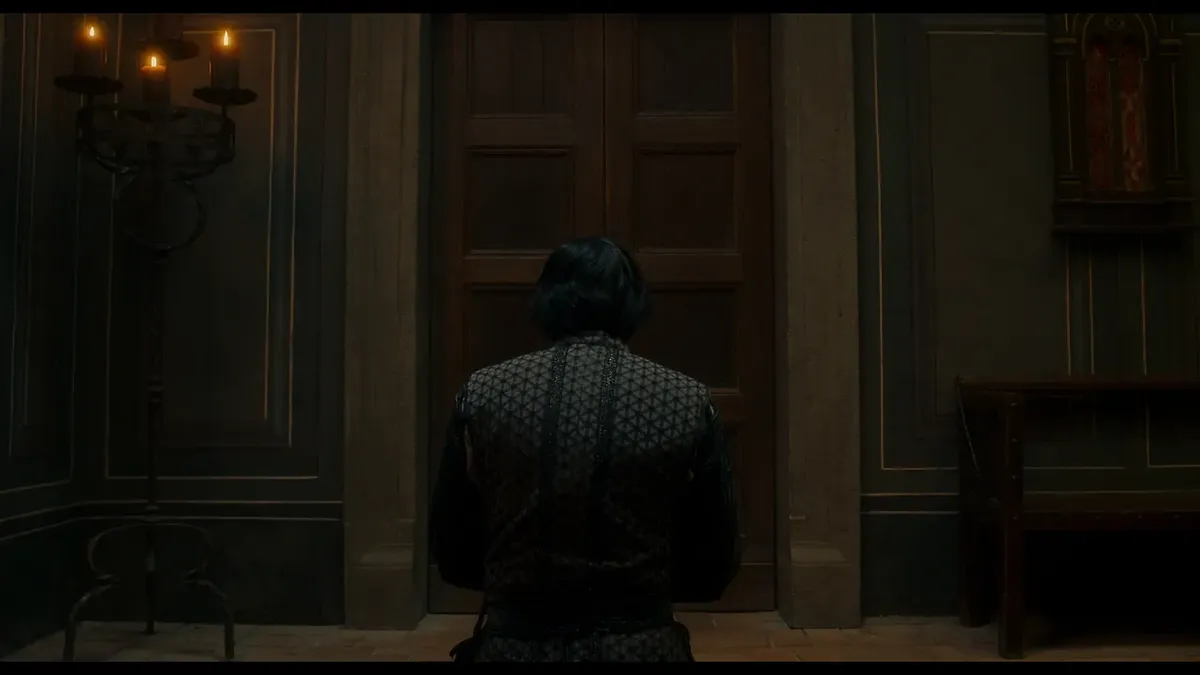
This scene brought me back to the feeling of childhood, where every confusing and overwhelming moment held the same stakes as the man in blue. Every big feeling, as kids gifted with the language call it, laid dormant inside that bedroom door—it’s not locked, but for years, you’ll be the only one brave enough to go in, even if you’ve never wanted to do it alone.
I know, my friend, that we’ve been through a lot. Our parallel lives have made us grateful that we have a well-structured home inside us, and that gratitude has taught us to overlook everything else: the haunted bedroom, the garden on fire, the leaky ceilings, the peeling wallpaper, the parts that don’t work, and the parts so out of date that we’re astonished when we witness the shinier parts of others.
Recently, I feel as though something has been ripped out of my programming, and I can’t tell yet whether it’s a good thing. In one of my letters to Robin, I talked about the undefined broken bits inside of us—Robin gently reminded me that adrienne marie brown calls those parts brokenbeautiful. These days, I don’t feel broken per se, but rather void and blank, like I am undergoing a factory reset in which my body is attempting to shield me from all the things my mind has been waging war against for longer than I can define. I feel to some degree, this must be how it feels to be a ghost. As I said once over drinks that I don’t fear dying as much as I fear the moment of disappearing, and the ghostliness of my recovery doesn’t feel like too distant of a cousin.
I know, Nour, that you understand what it’s like to feel so utterly lost within the folds of your mind. It is a hopelessly lonely journey, no matter how often you rehearse the parts you can say out loud. They say that’s really the crux of what therapy should be—a space for you to spill your guts and find your way with an observant stranger, so the ones who love you don’t have to hold you while you bleed. And yet, the cold rationality that we worship—the part of us that has been trained to be perfect and presentable at all times while taking up the least amount of space—has only brought us deeper into that loneliness. A good therapist will attempt to draw you out, but more likely, they will only affirm what you’re able to give. There are vignettes in our life that have never been spoken out loud, and the more we keep it shut behind closed doors, the more we envision ourselves in those stories to be far more monstrous than we are.
I’ve only just begun to realize that being like the man in blue has never gotten me anywhere. I am stuck in my patterns and envious of the freedom of the firestarter. At the same time, it’s hard to start a fire when you’ve trained yourself to see everything around you to be a blaze, and the only way you know how to earn anybody’s love is to put out fires.
More on love later.
Sparks
Do you remember that day where we sat by the water and talked about what it was like to feel orphaned by both parents while they are alive, yet utterly dispossessed of yourself and who you are beyond the value you bring to your family? I’ve spent the last few months writing and thinking about liberation and community, yet it is so ingrained in me—this haunting of my younger self—that I sometimes feel like an imposter.
Recently, I watched a movie called Palmer, where an ex-convict learns to care for a child who is simultaneously so authentic in himself and checking off every box in an Adverse Childhood Experiences questionnaire. This child lives and breathes gender fuckery like it’s the easiest, most natural thing in the world, and the beautiful thing is that in a world where one cannot be the nail that sticks up (or it will be hammered down), there is not only a child that possesses both a spark and courage enough to shine, but adults who recognize that spark as something worthy of protecting.
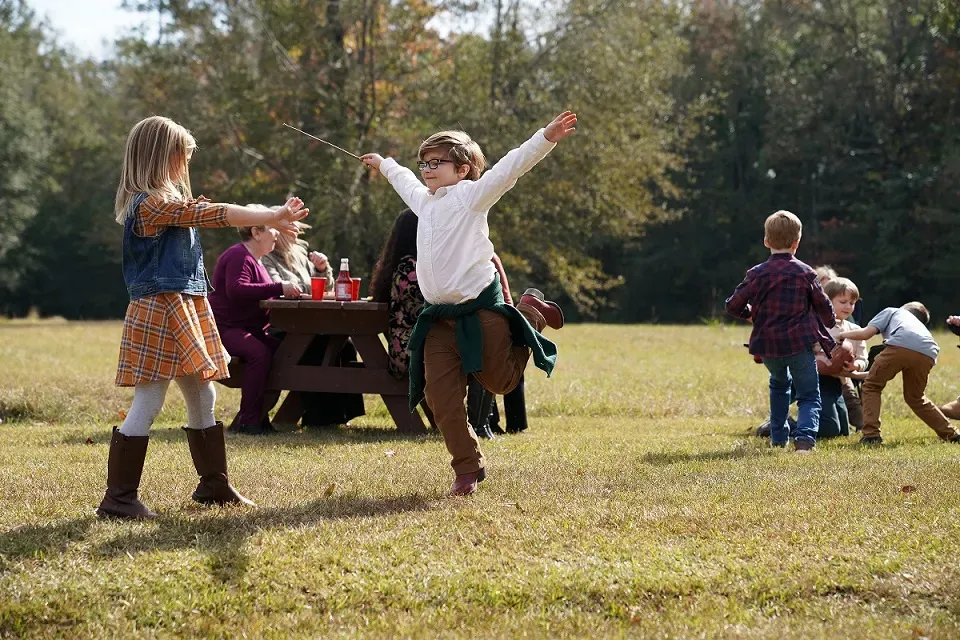
I believe you and I must’ve had a great spark when we were little. Something in us that yearned for things we didn’t have the name to, something we didn’t fear then but others taught us to later. Instead, you might’ve been the golden child, overwriting your spark to make others happy and never succeeding. I was the problem child converted into something gilded, and that incredible intuition I had about what I wanted, the fearlessness in which I conveyed that want, and the creativity I possessed was so quickly eroded away. I felt my spark turn monstrous, blasphemous, though you might have inherited another word for it, and when it finally sinks in that the adults might be right, and you might actually be broken or bad in some way…you spend a lifetime making up for all the ways you fall short.
I’ve been toying with the hypothesis that I fear success more often than I fear failure. As you’ve seen, my fear of rejection can be crippling, but failure feels like a more comfortable, familiar place to be at times. Success means you now have something to lose and the thing that is making you happy in the moment can be gone in a second. I remember you asking me what I was scared of when I was still wrestling with desperately wanting to feel good enough for someone I barely know, and I think I said I’m scared they’d change their mind. Something along the lines of rejection and pain and bracing for all of that, etc, etc. When I reflect now on that brief time—when I transpose the things I’ve been thinking about recently and the patterns that made me—there must’ve been no small part of me that feared being liked for who I was and being unable to trust it. Both feel true to me.
I heard it said once that neglected kids are addicted to coping. We find any reason at all to rationalize away our trauma responses—the things we do and feel that we can’t explain—often in ways most unkind to ourselves. After all, it’s hard to take your own feelings seriously when so, so few people do. It’s easy to move about different social circles fearlessly when relationships are transient things. It’s incredible when those transient moments turn a little more permanent. It’s terrifying when you realize you want both unconditional and forever and you have to trust others to hold the worst parts of you.
So you learn to patch up those little broken pieces of chaos inside of you and hope the worst of you is not as bad as you feel. And there are days where it will feel irreparable, but the thing that really breaks my heart is how common our experiences really are. I’ve seen it in so many kids, even before I could recognize it in myself—kids who tell me there is something wrong with them that can never be fixed. My instinct is to set fire to the systems that could put those words in that order into the heart and soul of these kids who are doing all they can to be the best versions of themselves.
My instinct is to also grieve a little for every time the world affirmed those feelings of brokenness as a child, feelings I have only begun to see through the vaguely translucent walls I’ve buried them in as an adult.
In other languages
Here in a white-dominated space where everyone else comes to assimilate, I’ve found times where I could spend hours talking about my world, yet it will get lost in translation. When our worlds cannot be so simply funneled into the lens of what is comprehensible to those who benefit from our extraction, we bastardized our own stories to fight the exhaustion of retelling it to an audience who don’t understand. What is the Disney version of intergenerational trauma in cultural exile, for example? Bastardized is a funny word, isn’t it? It speaks to an experience of orphaning in its own way—a bastard as one who knows their origins and is rejected for it. As such, to bastardize is perhaps to birth an idea, one where you can trace backwards in time and understand the purpose of its existence, yet reject it completely as something defective.
I was reading an article recently about Arabic as the language of grief, and the limits of English as a language of currency.
As I was reading it, an impossible to translate Cantonese word entered my brain: 忍 (yun). The character is a knife over a heart, with an extra barb attached to the end of the knife, and it means to withstand, to hold, to resign yourself to suffering—to hold a knife in your heart without complaining. Our culture has always been proud of all that we can withstand, all the blood, sweat, and tears embedded into every aspect of our lives. There is a sense that the West is delicate, and the one thing we can hold over them is our ability to work harder, do triple the work in half the time, and above all, never lose our footing no matter what comes our way. To say 忍 out loud is to indicate that you don’t like what’s happening—it’s an open invitation for the other to relieve your suffering, yet never make the move to remove that knife, that badge of honour, on your own. Simultaneously, we tell our children to 忍 when they scrape their knees and cry. It is a word that is value neutral, like so many in Chinese, until it is paired with another and situated in context.
English grew out of a world that is used to forced assimilation, to assigning specific melodies to each word so they can remain the same in any context. It takes from other languages and sometimes makes monsters of those words. For example, I think of the word kowtow, which comes with a disdainful air of subservience. To kowtow to someone is to lick their boot, to follow them off a cliff, and smile unquestioningly while you do it. It’s a word that traps us in history, yet can’t make sense of the culture in which it was created. China’s culture of bowing has long since been eroded away. To 磕頭 is to live in the past, and we no doubt have internalized the western disdain for it to some extent. I think of traditional weddings, where a couple will honour their families and each other with a 磕頭. The bowing looks different now, and maybe the reverence does too. Maybe we don’t actually have a way to honour each other the way we used to.
Since I’ve moved away from the big city, I’ve been hearing my own accent change—the words don’t come as easily as they used to, and I sound foreign even to myself. I watch videos sometimes to hear Cantonese in the accent I once felt sure of. I try to learn new phrases and carve the old into my brain. It doesn’t always stick. As I’ve grown a bit more into myself, as I’ve begun to live more authentically—casting away slowly that Hannah Montana life, as you call it—I’ve been feeling oddly lonely in this journey. In movies, being able to live unapologetically yourself is the greatest feat a queer person can achieve. And yet, they never talk about the grief of compartmentalizing your life when the ones you love can only love you in a different language. What is liberation then when there are no words to convey our joys and our sorrows to the other half of our lives? The difference between us and Hannah Montana is that both Hannah and Miley live in the same world. Florence and Nour, alongside 吳沅瑤 and نور, live two parallel lives: one half building a dream, halfway guilty for the compromises we’ve made, and the other half caught in the yearning of the past, trapped in a world we don’t always understand, yet know that we will never see again.
Neither halves knowing what to do about the future ahead. Neither halves really knowing how to hold each other in the first place.
Chameleon
I once wrote a story of a shapeshifter whose ability malfunctioned to the point where they were shifting uncontrollably into another person every few seconds.
In the stories we’ve exchanged about our families, we’ve often had to take up the role of shapeshifter at the drop of a hat. The big emotions around us can be so wonderful, then plummet without warning, and we will be whoever we need to be to catch them. Because nobody else will. Being a shapeshifter is lonely, and there are days where you’ve shifted so many times that certain faces begin to stick—that’s who you are now, and still your body may not feel like your own.
In the story, the shapeshifter is tied down when she couldn’t stop shifting, and her magic is stripped from her. Though it saves her life, she describes it like a phantom limb, like a part carved out of her she will never get back, and she misses it. Similarly, our ability to shift can be wonderful. We can sit across from a person and feel so connected for one hour—and we can do that for a living!
Being a shapeshifter can also be exhausting, because it’s not just you changing in a context—your whole reality warps into something that you must now adapt to. There is emotional labor to unmeshing from multiple selves and healing from the injuries we sustain along the way. There is also the constant wondering of whether or not another version of yourself would be preferred. You can gather a room full of people who profess to care for you and still feel like the loneliest kid in the world.
I’m fine (I’m not fine)
As I am writing these words, you are going through one of the hardest weeks of your life, and it’s in these moments I feel the limitation of language. To capture the full breadth and depth of grief is impossible, and to try would do a disservice to you. I’ve heard the ways we sanitize ourselves and our emotions, colour them presentable as we proffer them up to be witnessed, to be held and understood, yet bookended by cries of how fine we are—lest we make others uncomfortable by revealing how not fine we actually are.
By definition, fine implies neutrality erring on the side of positivity. To be neutral is to exist with the potential to hold or become any and all states of being—shapeshifters, so to speak. In Shanspeare’s recent essay on dark romance, she says that “The version of ourselves that feel the most true is the version that is most familiar to us—the one that is most comfortable—the one that fits the most neatly into society, amongst people, and under public opinion.” In the context of dark romance, she hypothesizes that the darkness of the brooding lover brings out the darkness of the wandering wide-eyed beloved, and while there is a liberation of the self, there is also isolation as the pair are both cast out. (Think Bella, who steps into her own power by becoming a vampire, yet must give up the life she had to do so). Our attraction to the things we do not possess is perhaps part of desires we’ve never spoken to ourselves—desires that are so alien that they “[sit] at odds with the concept of identity”. Identity that, as shapeshifters, is never truly cemented in the one that is good and pure. In quoting Hungerstone, Shanespeare highlights the protagonist’s anxiety around Carmilla, her vampire lover. She asks, “What have you done to me?” and Carmilla responds: “I have set you free…It is terrible to be alive. But it is worse to be dead to ourselves.” To return to the thread of neutrality, shapeshifters contain both the potential to return to comfort and diverge into something we perceive as sinister. And perhaps both can exist in tandem, one above and one below. It is, as Carmilla says, when we are dead to ourselves in all of our shifting, that feels so terrible.
Who are you in this moment, I wonder, as you’re reading this? Who am I, for that matter, as I am typing this out?
I’ve been bobbing along unmoored in the darker seas of my brain, and only recently, I realized I have been thinking about the one person I promised myself to stop thinking about. I don’t understand it really, as the attraction now feels at odds with other things I feel. And yet, desire isn’t something you can intellectualize away. Only buried alongside that chaotic entity trapped beneath years of smiling and surviving, and I’ve been trying to do a little less burying—maybe a little more flowing along the grain of discomfort. They say that when you are bitten by a shark, you have to go against the instinct to pull away. Instead, you turn around and fight for your life head on. Being discomforted by everything I’ve been feeling and thinking is a little like that, and on the days when you’re lucky, you can—in the heat of the moment—remember to do the opposite of what feels protective. You feel it out and pray it won’t hurt down the line.
Perhaps this person is a distraction against the impossibility of other desires. It is a painful thing sometimes to reveal the soft parts of ourselves and give into wanting. And yet we do it anyway: desiring alternate futures for our parallel selves, desiring the kind of seenness that could heal any open wound, desiring open invitations to exist with our messy, impulsive inner children, etc. Impossibly, we dare to desire love that can coexist with each iteration of our shapeshifting selves, and be held and seen when shapeshifting inevitably becomes untenable. Amazingly, we desire because there is someone underneath all of who we are supposed to be—someone who simply is.
The point is, there is a very possible world in which all that we desire is right in front of us. And still, I’m not convinced any singular force could help you believe in the things that others tell you. We sit so comfortably in the things we tell ourselves, even when—especially when—they are unkind, that it becomes second nature to brush another’s acts of care off like dirt off your clothes. Perhaps it might help to hear words of affirmation over and over until you create some sort of Pavlovian self-love response—or perhaps you’ve tried for years and it still hasn’t happened, but if I just hear it a little more…if I just model it to myself a few more times…if I could just reframe it…if…and if…and if… If everything just changed and everything could just be the same or different—that’s always how it goes, isn’t it?
I’ve been watching Sort Of lately, and it has me thinking about the archetype of the wounded, neglected eldest girl child. I remember talking to our friends about this—the differing wounds we carry in this role. As golden child, problem child, parentified child, as the child who never shows her anger or her sadness, and/or all of the above and beyond. We learn to take it out on ourselves, and in the moments we slip up, on others around us. In Sort Of, despite immense love for them, there are many moments where the sister takes it out on her sibling. Embarrassingly, in those moments I found myself judging her for not putting herself and her resentment aside for her sibling also—after all, she already does it for everyone else in her family, and her sibling holds the least fault for her pain in my eyes. I judged her too for not taking on her parents mistakes and loving her sibling harder than their parents were willing and able. When I finally caught myself, I was almost envious of her beautiful rage.
What might mine look like, I wondered, when I finally find the key to its cages.
I’ve been thinking a lot more about curiosity as the conduit to building that trust with others and ourselves. Perhaps fixing shattered internal worlds is moreso about picking up the pieces and co-recreating them with the people who profess to love us, people who can reframe the fractures and paint gold over them. I confess I don’t know what all of this means yet. Love in its many iterations has broken me up more times than I’ve given it a chance to put me back together.
All I know right now is that in darkness and in light, there is creation.
And someday, my rage will be reborn.
Rebuilding
At the end of this essay, I’m reminded of the story you wrote of the windows, and the vignettes of everyday life in liberated Palestine. I think of the kids in those stories, no longer needing to throw rocks to protect their home as final acts of defiance, and the communal rebuilding of Abu Suhayb’s home. It’s really such a beautiful story, my friend.
You’ve no doubt heard and said every platitude in the book whenever you hear the creaking of another’s internal house. We’ve trained ourselves so well to act at the first hint of distress, after all. Maybe you’ve even told yourself the very same platitudes, intellectualizing every imperfection on the wall, in the ceilings, in the haphazard decor that fill our rooms. Whatever it takes to convince ourselves of what we need in the moment. But what does it take to believe others when they tell us we’re okay? What does it mean to let another’s care for you mend your wounds? To trust in another so deeply and unwaveringly…I don’t know if I know.
I wrote earlier of our internal homes and the sturdy frame we’ve been given, even when we feel like run-down fixer-uppers. There is, as you’ve said before, only so much we can do to embark alone on a home renovation journey as big as this, and I wonder now what it would look like to give into that exhaustion and let others clear the rubble once in a while. What would it look like to sing and dance and take our time as we pick through paint chips together as we finally tackle the peeling paint? We can listen to “Crème Brûlée” and line dance like those Asian aunties. Then we’ll share a meal, and maaaybe in the morning, we’ll finally fix that leaky faucet inside us that never stops dripping.
And maybe it’ll all fall apart by Tuesday.
Maybe a bull will run through and tear out the floorboards again.
Maybe the wearing and tearing is subtler than that: like water expanding wood and rusting on hinges when you least expect it.
Or maybe it’ll stand a little longer than we ever thought possible.
With love,
Florence